

Half of American consumers used an AI tool to find or research a local business in the last month, and almost none of them took its word for it. That pairing is the useful finding in SOCi’s 2026 Local Discovery Index, and it cuts against the way most businesses are being told to think about AI search right now.
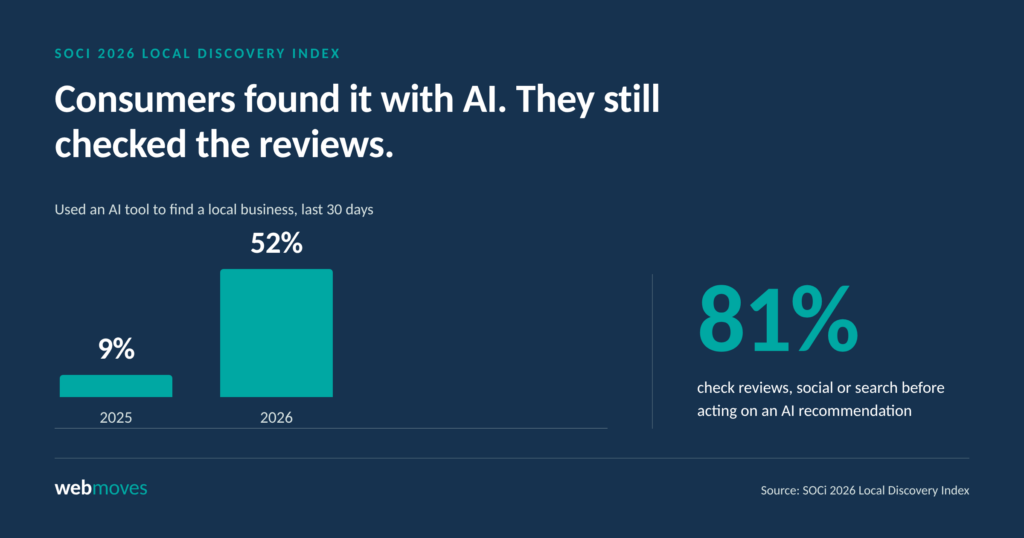
The adoption number is real. The share of consumers who used AI to find a local business in the past 30 days went from 9% in 2025 to 52% in 2026. What did not move with it was trust. Among people who use AI, 67% say a tool has given them wrong information about a local business at least once, and 30% say the bad information caused an actual problem. Only 27% say they trust AI more than they did a year ago, which leaves 73% who do not.
So when an AI recommends a business, 81% of consumers go and check something else before they act on it. Only 19% contact the business directly. A third check reviews first, a fifth look at the company’s social profiles, 16% search the name to confirm the details, and 12% consult several sources. SOCi calls this the verification loop, and the name is fair: people discover in one place, verify in another, and decide in a third, often inside a few minutes.
The practical consequence is that winning the AI answer is not the finish line. It gets a business onto a very short list, and then the reviews and the social profile decide whether it survives the check. A brand with a good AI mention and a thin, unanswered review profile can lose the customer at a step it never sees.
Millennials lead AI use for local, not Gen Z
The generational split does not run the way most marketing decks assume. Millennials are the heaviest users, at 63% having used an AI tool to research a local business in the last 30 days. Gen Z sits at 49%, barely ahead of Gen X at 48%, and Boomers trail well behind at 11%. The curve peaks in the middle of the market rather than at the young end of it.
Income tilts the same way. Regular AI use runs from 47% of consumers earning under $50,000 to 76% of those earning $100,000 or more, and the local-specific number climbs from 40% to 65% across the same brackets. For any business whose customers skew older and wealthier, that is worth sitting with: the AI-visibility question is not a Gen Z question, and it is not a question for later.
Consumers also meet AI in two different ways. Some go looking for it, mostly through ChatGPT (57%) and Gemini (51%), with Copilot at 19%, Siri at 17% and Claude at 15%. Others encounter it without choosing to, and that group is now larger than it looks: 51% see an AI answer at the top of Google, 35% have been pulled into Google’s AI Mode, 32% run into Meta AI inside Instagram or Facebook, and 31% see AI content in mapping apps. If a business has never checked how it appears in any of those surfaces, it is not opting out of AI search, it just isn’t reading its own results. We’ve written separately about what actually makes a page legible to AI search.
Facebook and YouTube carry social discovery, not TikTok
Social is doing more search work than its reputation suggests. Among consumers, 55% turn to social for local recommendations and 43% use it to preview what a place is actually like before going. Among the people doing that, Facebook leads at 73% and YouTube is second at 69%, ahead of Instagram at 67% and TikTok at 50%. The two workhorses beat the two trend platforms, though TikTok skews sharply younger and is the one platform Gen Z prefers over Facebook.
What people want from a local brand’s social presence is mostly practical rather than entertaining. They follow to preview the place (42%), for useful content (41%), to see the menu or offerings (38%), and to see what other people think (35%). Entertainment comes in at 33% and deals last at 25%. That ordering should shape what gets posted: a current photo set of the actual premises does more work here than a campaign asset.
It converts, too. Across all consumers, 59% say a social post or video directly made them a customer of a local business, rising to 70% among Millennials, 54% for Gen X and 52% for Gen Z, then dropping to 22% for Boomers.
The cheapest problem in the report is missing information
Sixty-three percent of consumers have walked away from a business because it could not answer a question they needed answered. No ranking work fixes that, and no AI strategy compensates for it. Hours, services, whether a place takes appointments, what it actually sells: these are the details that decide whether someone in the verification step keeps going or moves to the next option.
For a business that covers several towns, that information problem is usually a location-page problem. Which is a separate question from how many service area pages you should have in the first place — a question with a clearer answer than most people expect.
This is the finding that transfers most cleanly to a single-location business. Most of the report is written for multi-location brands worried about consistency across hundreds of listings, and a single-site operator does not have that problem. What they do share is the consequence when a consumer checks and finds nothing.
Reviews decide the shortlist, and responses decide the return
Reviews are close to universal now: 99% of consumers read them at least some of the time before a first visit, and 68% do so always or most of the time. That is the gate. Ratings below the local standard tend not to make the list at all, and AI tools lean on the same review data when they assemble a recommendation, which is part of why where AI reads your reputation matters more than it used to.
The more actionable half is what happens when a business replies. Seventy-two percent are more likely to choose a business that responds to its reviews. Sixty-five percent would be more likely to come back after a helpful response to a bad review. And 87% say they would likely revise a negative review to a positive one if the business responds helpfully. Very few marketing activities have a number like that attached to them.
Review sensitivity also rises with income. Reading reviews always or most of the time goes from 63% of consumers under $50,000 to 76% of those over $100,000; preferring businesses that respond goes from 62% to 80%; and returning after a helpful response goes from 53% to 74%. A brand’s highest-value customers are also its most reputation-driven ones.
Where people start, and what closes the sale, changes by category
Search is the most common starting point in every category the study covers, but the second channel varies enough to matter. AI-first journeys run highest in healthcare (21%) and grocery (19%). Social starts a fifth of financial-services journeys (20%), well above its share elsewhere. Mapping apps are the first stop for a quarter of fuel and auto searches (25%). Property is the most search-dominated category at 53%, and hospitality the least at 34%.
The deciding factor moves too. Reviews and word of mouth lead in five of the eight categories, from restaurants (41%) to healthcare (38%). Visual content is the top factor in property at 43%, where people want to see the thing before they commit. Location and hours top the convenience categories, grocery at 37% and fuel at 36%. Brand and credentials spike in financial services at 34%. And in healthcare, the most research-heavy category, AI recommendations rank among the leading factors at 33%.
Vertical sites did poorly across the board, which is one of the quieter findings here. Hotels.com for hospitality and Zillow for property both drew low shares as starting points, suggesting consumers are defaulting to general-purpose tools rather than industry-specific ones.
What to actually do with this
- Complete the boring fields first. Hours, services, categories and attributes across the profiles a consumer might check. The 63% walk-away figure is the cheapest thing on this list to fix.
- Ask the AI tools what they say about you. Query ChatGPT and Gemini for your business and your category in your city, and record what comes back. With 67% of AI users reporting wrong information at least once, assume some of it is wrong until you have looked.
- Answer reviews as a standing routine, not a campaign. Both the 72% preference and the 87% revision figure depend on a response existing, and neither rewards a burst of activity followed by six quiet months.
- Post proof of the place, not brand assets. Preview (42%) and offerings (38%) are why people follow local brands, and Facebook and YouTube reach more of them than Instagram or TikTok.
- Check your own category’s pattern before copying anyone’s playbook. A property firm needs visual content that a fuel retailer does not, and a healthcare provider has an AI-recommendation problem that a grocer largely does not.
What the report does not establish
SOCi sells local marketing software to multi-location enterprises, and each takeaway in the report ends with a pointer to one of its products. That does not make the figures wrong, but it does shape which findings got emphasized, and the recommended fix is consistently software. Read it with that in mind.
The data is also self-reported. SOCi surveyed more than 1,000 US consumers, weighted to the population, with a median age of 39 and a median household income around $81,600. People describing their own behavior in a survey are not the same as people observed doing it, and a survey that size supports the broad direction of these numbers rather than fine distinctions between them.
Two figures in circulation from this report are easy to conflate, so it is worth separating them. The 9% to 52% jump measures using AI to find a local business specifically. The separate 19% to 60% figure measures using AI tools at all in a month, across every purpose. They are different questions, and averaging them produces a number that means nothing.
Frequently asked questions
Does ranking well in AI answers win the customer?
Not on its own. When an AI recommends a business, 81% of consumers check something else before acting, most often the reviews (33%) or the social profile (20%). The AI mention earns a place on the shortlist; the reviews and social presence decide what happens next.
Which generation uses AI most to find local businesses?
Millennials, at 63% in the last 30 days. Gen Z follows at 49%, Gen X at 48%, and Boomers at 11%. AI use for local discovery peaks in the middle of the market, not at the youngest end.
Which social platforms matter most for local discovery?
Among consumers who use social to find local businesses, Facebook leads at 73% and YouTube is second at 69%, ahead of Instagram (67%) and TikTok (50%). TikTok skews younger and is the platform Gen Z favors over Facebook.
Is responding to reviews worth the time?
The survey figures are unusually strong on this point: 72% are more likely to choose a business that responds to reviews, 65% would return after a helpful response to a bad review, and 87% say they would likely revise a negative review to a positive one if the business responds helpfully.
The source
Every figure above comes from SOCi’s 2026 Local Discovery Index, subtitled “The Verification Loop: How Consumers Discover Local Brands Across Search, Social, AI, and Reviews”. It is the third annual edition of a study formerly published as the Consumer Behavior Index, and the methodology and year-over-year comparisons are set out on its final pages. The report is a free download from SOCi and worth reading in full if local visibility is part of the job.
The through-line, and the reason the report is worth the time despite its commercial framing, is that these channels stopped being separate campaigns some while ago. A consumer meets a business in an AI answer, judges it by its most recent reviews, and decides from a social video, in whatever order they like. The click is not the outcome any more, and neither is the ranking. The consistent answer across every surface a person might check is what closes the gap.