Local Services Ads

The only ads that sit above the ads.

Local Services Ads are the panel of businesses with green check marks at the very top of a local service search, above the paid results and well above the organic ones. Google charges you per lead rather than per click, a lead is a phone call or a text message, and almost nothing you know about managing Google Ads transfers across. For a plumber, an HVAC company or a pest control firm it is usually the single easiest thing to switch on and the easiest to leave running badly.

0

Clicks you pay for. Local Services Ads are priced per lead.

3

Businesses in the panel before a searcher has to tap for more

1.8 x

What a phone lead costs against a text lead, in the accounts we run

90 %+

Top impression rate on Search we hold in those accounts

// What It Is

Six ways this is not Google Ads

People arrive expecting a campaign type and find a different product with a different rulebook. Every one of these differences changes what you would do in a given week.

You pay per lead, and a lead is a call or a text

A charge happens when somebody phones, messages or books through the ad. Browsing costs you nothing. That sounds strictly better than paying per click and it moves the risk rather than removing it, because the thing you now manage is lead quality rather than click quality.

It is newer than it looks, and older than people say

Google started this as Home Service Ads in a San Francisco pilot in 2015 and spent years widening it. What is genuinely recent is availability: the expansion across metros and into categories beyond home services mostly landed in the last two or three years, which is why plenty of businesses only got the option lately and why it still feels like a new product.

Google checks you out first

License, insurance and a background check on the business and often its owners. For home services the badge is Google Guaranteed; for professional categories such as legal and financial it is Google Screened. The verification is the product, and it is the barrier that makes the placement worth something.

There are no keywords

You choose service categories and a service area. No keyword list, no match types, no negative list, no ad copy. Your listing is the business name, the rating, the review count, the hours and a badge, which is a much smaller surface to optimize and a much less forgiving one.

You will need somewhere for the leads to land

Calls and texts arrive as leads rather than as form fills, so in practice this needs a CRM behind it to track the conversation, hold the history and make sure nothing sits unanswered. We run ours on HighLevel. Without something in that slot the leads are in an app on somebody's phone, which works right up until it does not.

Bad leads are disputable

Wrong service, outside your area, spam, a duplicate of one you already paid for: all of these can be disputed and credited. It is the most neglected part of running LSA and the difference between a real cost per lead and a flattering one.

What the reporting actually shows you

This is the LSA Reports overview from one of the accounts we run, for July 2026. The spend and the lead counts are blacked out, because those belong to the client. The two percentages on the right do not, and they are the ones worth looking at.

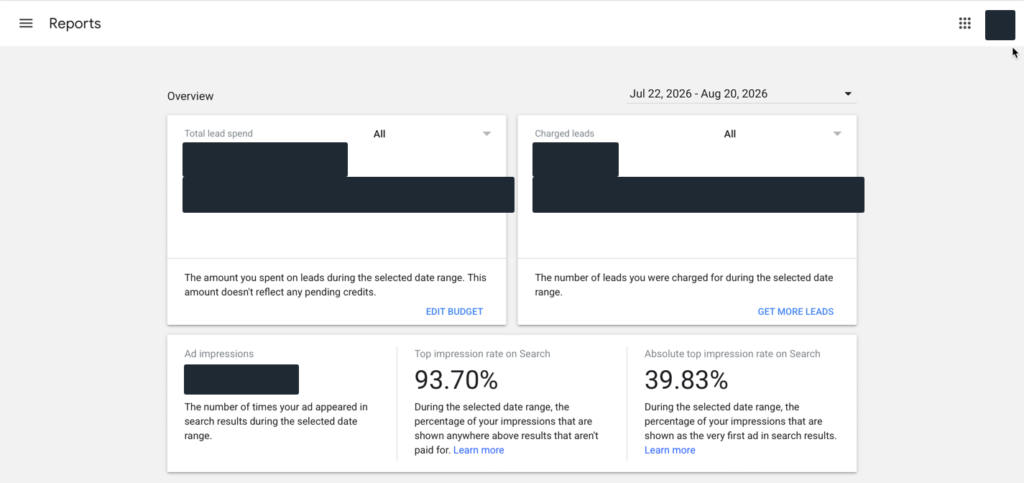
Top impression rate on Search is how often your ad appeared anywhere above the unpaid results. Absolute top impression rate is how often you were the very first. Across the two accounts in this section we hold above 90% on the first figure, and the second is where the accounts differ sharply — 20.24% in this one and 39.83% in another over the thirty days to 20 August. Same program, same category of work, and roughly double the share of first position.

That gap is the whole argument for managing these rather than switching them on. It is not budget. It is reviews, response times and how tightly the service area is drawn.
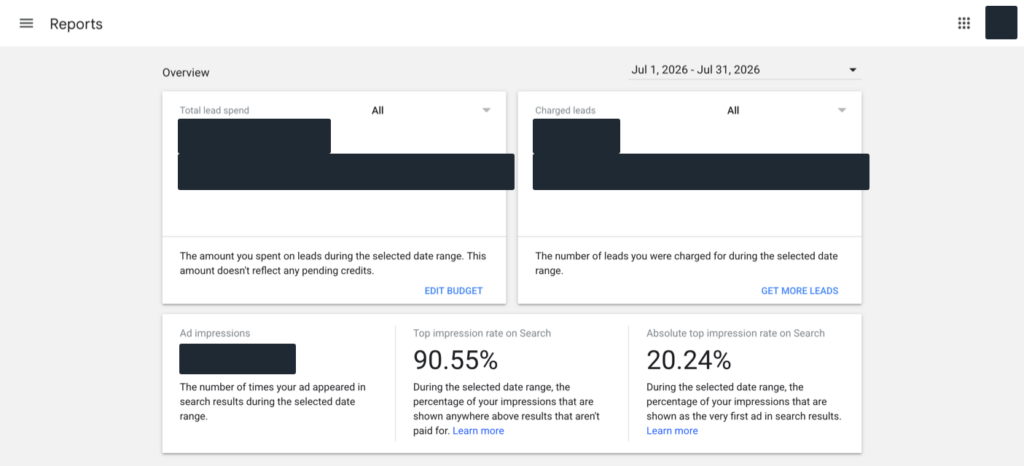
Google Local Services Ads Reports overview for July 2026, showing a 90.55% top impression rate on Search and a 20.24% absolute top impression rate. Spend and lead counts are redacted.
// Calls And Texts

A phone lead costs about 1.8 times a text lead

Measured across two accounts we run, independently, over July and over the thirty days to 20 August 2026. It is the most useful thing in the reporting and almost nobody looks at it, because the dashboard shows you the two totals side by side and leaves you to do the division.

The ratio held in both accounts

A charged phone lead came out at 1.88 times the cost of a charged message lead in the first account and 1.76 times in the second. Two different accounts, two different periods, near enough the same answer, which is what makes it worth writing down rather than treating as a quirk of one month.

They arrive in roughly equal numbers

The lead mix ran 51% phone and 49% message in the first account, 54% and 46% in the second. So calls and texts turn up about as often as each other, which is not what most owners expect and is worth knowing before you decide which one to staff for.

Which means calls take two thirds of the budget

Phone leads took 66% of the spend in the first account and 67% in the second, for about half the leads. That single sentence changes how you think about the answering problem: the expensive half of your lead flow is the half that hangs up if nobody picks up.

What we would not conclude from it

That text leads are better value. They are cheaper per lead and we have no close rate attached to them here, so anybody telling you which converts better is guessing. What it does justify is measuring the two separately from the day you switch on, which most accounts never start doing.

// Ranking

What actually decides who appears in the panel

Only three businesses show before somebody has to tap for more, so the difference between third and fourth is most of the value. Google has been unusually open about what feeds the order, and none of the main factors are things you can buy your way past in an afternoon.

How close you are to the searcher

Proximity does much of the work, so a service area drawn too wide quietly under-performs everywhere in it. Tightening the area usually raises the rank inside the part you actually wanted.

Your review score and how many you have

Ten reviews is the gate: you cannot open a Local Services Ads account without them, so for a business sitting on six this is the first job rather than a later one. Past the gate they keep working, because the score and the count both feed the ranking and the reviews on your Business Profile are the ones that count. Review generation stops being a nice-to-have and becomes part of the media buy.

Whether you answer, and how fast

Response rate and speed to calls and messages feed the ranking directly. A business that misses calls at four in the afternoon is being demoted for it and usually has no idea that is what is happening. This is also why the CRM matters more here than the ad settings do.

Your hours, honestly set

The panel favors businesses open when the search happens. Listing hours you do not really cover buys you leads you then answer badly, which costs twice.

Complaints against the business

Serious or repeated complaints affect standing and can cost the badge outright. The verification that makes this placement valuable is the same verification that can be withdrawn.

Budget, but less than you would think

Budget governs how much of the available demand you can take rather than where you sit against a rival with better reviews and a faster phone. Raising it does not buy you past the proximity and reputation signals, which is a hard conversation to have and an honest one.

John Wieber on running these accounts

Local Services Ads give a home services business something the rest of Google Ads does not: you pay for a lead instead of a click. The lead is a phone call or a text message, and you need a CRM behind it — something to track the calls and the texts, hold the history, and let you answer the customer on what they actually asked for.

Google varies which businesses it sends a lead to, so you share the flow with your competitors rather than owning it. But it is the top three results, almost exclusively, for anyone searching for a plumber, an HVAC company, pest control or any other trade.

It suits small businesses because it is easy to implement. Beyond configuring the business and putting a card on the account, there is very little to manage: you set it up and the leads arrive. Grading them is the exception. It is still done one lead at a time as they come in, and that is a real handicap to LSA as it stands.

You need a Google Business Profile and at least ten reviews. You cannot open an account without them. After that it is a credit card and a working account, and it will send leads to almost any new business. Where you rank comes down to how fast you answer calls and texts, and where you sit on the map relative to the person searching.

The handicap he names is the one we are building into: grading and tracking driven off the CRM record rather than off somebody remembering to click. We have it running on HighLevel and are extending it. Marking every lead by hand is workable at ten a month and it is not at two hundred, which is roughly where the account in this screenshot sits.

Google Local Services Ads Reports overview for the thirty days to 20 August 2026, showing a 93.70% top impression rate on Search and a 39.83% absolute top impression rate. Spend and lead counts are redacted.
// The Weak Spot

Lead grading is the part Google has not built

Everything else about LSA is genuinely easy. This is the one place the product runs out, and it is the place where the money leaks.

Grading is manual, one lead at a time

Google lets you mark each lead as it comes in — booked, not a fit, spam. That is a per-lead click by a human being, and it is the input the dispute process and your own reporting both rest on. At a low lead volume it is fine. At a few hundred a month it stops happening, and once it stops the reported cost per lead drifts away from the real one.

Which means disputes get missed

Leads you should not have paid for are only credited if somebody raises them. An account nobody grades is an account quietly paying for wrong-area calls and spam texts every week, and the number never appears anywhere as a loss.

We are building the dynamic version

Grading and tracking driven off the CRM record rather than off somebody remembering to click, so the lead is scored by what actually happened on the call or in the thread. We have it running on HighLevel and are extending it. It is not a Google feature and we do not expect one.

What to do until then

Grade for one full week and count what you would have disputed, then multiply. Most owners we do this with are surprised by the number, and it is usually enough to justify putting a process behind it.

// Process

How we run it

Four things on a monthly loop. The first two are setup you only get one clean shot at, and the last is the one nobody does.

Get verified, and keep it that way

License and insurance documents, the background check, a Google Business Profile, and the categories set to what you actually want to be called about rather than everything you are legally allowed to do. Verification lapses quietly when a document expires, and the ads stop.

Data in →

Draw the service area to fit the vans, not the ambition

Proximity is weighted heavily enough that a wide area dilutes the whole account. Better to own a tight radius and extend it once the review base can carry it.

Strategy →

Put the leads somewhere, and answer them

A CRM holding the calls and the texts, so nothing sits unanswered and you can see the history when the same person calls back. Response rate is a ranking factor, which makes this an advertising job as much as an operations one.

Execute →

Grade and dispute, every month

Out of area, wrong service, spam, duplicates. Unglamorous administration, and the difference between the cost per lead you report and the cost per lead you are actually paying.

∞ Loop
// Worth Knowing

Two more things before you sign up

Both are from running this rather than from reading about it.

The interface has been genuinely unreliable

In September 2024 we wrote up a stretch where the sign-up forms reset themselves repeatedly and the budget screen would spin without ever saving. It happened in Chrome and in Firefox, and the thing that eventually worked was doing it in Brave. We mention it because a lot of businesses conclude they have done something wrong, and reasonably often they have not.

It does not replace your paid search account

Local Services Ads cover a defined set of categories and a defined moment of intent. Everything either side of that moment — the research, the comparison, the people searching for a product rather than a trade — is still bought through the ads underneath, which is why this page sits inside a paid search practice rather than beside one.

// Testimonials

What people say about working with us

We have been working with John and Web Moves for 14 years and the results have been astounding. John is a straight shooter — if he says he can do it, you can be confident he will deliver.
S

Shaun O'Brien

Owner, Selby Acoustics

Shaun was John's client

The great thing about John is his honesty — he tells it like it is. He is respected by major players including Microsoft and eBay, and media seek out his views: the front page of the Wall Street Journal among them.
P

Phil Leahy

Founder, MedCart Marketplace & Retail Global Events

Phil was John's client

John is the single most knowledgeable individual in the SEO industry I have ever worked with. Whether as a client, vendor or business partner, I cannot recommend him more highly.
M

Matthew Kligerman

Building Dirt — AI land development platform

John was Matthew's client

// Questions

Frequently asked questions

What does a lead actually cost?

It varies by trade and market, but the ratio inside it is consistent. Across two accounts we run, a charged phone lead costs roughly 1.8 times a charged message lead while both arrive in near-equal numbers, so calls take about two thirds of the budget for about half the leads. That is worth knowing before you decide how to staff the phone.

Do we qualify?

You need a licence, insurance and a passed background check to earn the badge, and at least ten reviews to open an account at all. If you are sitting on six, that is the first job, and no amount of budget substitutes for it.

Can we dispute leads that were not real?

Yes, and grading is where most accounts quietly lose money. Google lets you mark each lead as it arrives, one at a time, by hand. At ten leads a month that is fine. At two hundred it stops happening, and the cost per lead you believe you are paying drifts away from the one you are actually paying.

Is it better than paid search?

Different rather than better. It is usually the easiest thing to switch on for a home services business and the hardest to manage well past the first month, because ranking rests on proximity, review volume and response time rather than on anything you can bid past.

// Next Steps

Wondering whether you would even qualify?

Tell us the trade, the licenses you hold, the area you cover and roughly how many reviews you have. We will tell you whether Local Services Ads are open to you, what the verification will ask for, and whether your review base is strong enough for the panel to be worth entering yet. If it is not, we will tell you what to fix first.