
Every service business that covers more than one town eventually asks the same question. We serve forty towns. Should we build forty pages?
The answers you find are confident and contradictory. One agency says ten to fifteen, maximum. Another sells a template for building hundreds. Somebody in a forum says Google penalised their client for exactly this. Somebody else has a client ranking perfectly well with pages that are almost identical to each other.
We spent a week reading around sixty-five sources on this: Google’s own documentation and patents, the leaked Search API documentation, controlled split tests, large-scale studies, and the practitioner case studies that everybody quotes. Some of it contradicted advice we have given ourselves. Here is what the evidence actually supports.
The short answer: the number is not the test
Google published the test in March 2015, in a post called An update on doorway pages, and it has never been withdrawn. It is five questions. If your location pages answer them well, having sixty is fine. If they answer them badly, having twelve is a liability.
So stop asking how many pages you should have. Start asking whether each page says something that is true only about that place.
Google’s five questions, and the one nobody quotes
Here they are, in Google’s words:
- Is the purpose to optimize for search engines and funnel visitors into the actual usable or relevant portion of your site, or are they an integral part of your site’s user experience?
- Are the pages intended to rank on generic terms yet the content presented on the page is very specific?
- Do the pages duplicate useful aggregations of items (locations, products, etc.) that already exist on the site for the purpose of capturing more search traffic?
- Are these pages made solely for drawing affiliate traffic and sending users along without creating unique value in content or functionality?
- Do these pages exist as an “island?” Are they difficult or impossible to navigate to from other parts of your site? Are links to such pages from other pages within the site or network of sites created just for search engines?
Almost every article about doorway pages quotes the first question and stops. The fifth is the interesting one, and it is the reason this article is also about internal links.
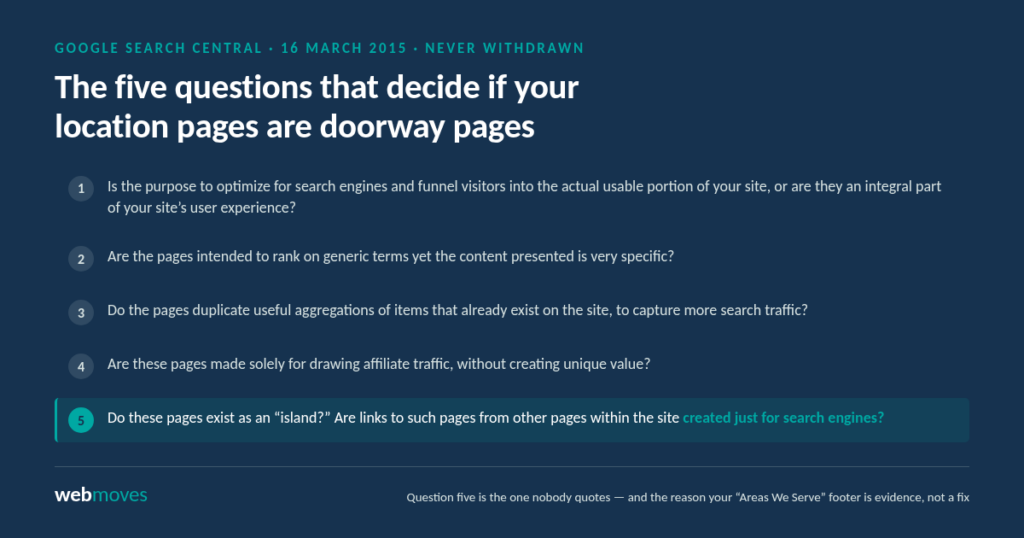
Read it again. Google names “links created just for search engines” as a doorway signal.
Think about what that means for the standard setup. You build forty town pages. Nothing on the site naturally links to them, because nothing on the site naturally needs to. So you add an “Areas We Serve” block to the footer, listing all forty, on every page.
You have just built the thing the fifth question describes. The footer block is not a fix for the island problem. It is the evidence of it.
The spam policy is about purpose, not templates
Google’s spam policies define doorway abuse as “sites or pages … created to rank for specific, similar search queries”, and the first example given is “multiple domain names or pages targeted at specific regions or cities that funnel users to one page”.
Notice what is not in that definition: page count, word count, or templating. The policy turns on purpose, and on whether the visitor gets anything.
The same is true of the scaled content abuse policy Google added in March 2024. The wording is worth quoting exactly, because it settles an argument people are still having:
Scaled content abuse is when many pages are generated for the primary purpose of manipulating Search rankings and not helping users … no matter how it’s created. … ensuring that we can take action on scaled content abuse as needed, no matter whether content is produced through automation, human efforts, or some combination of human and automated processes.
So “a human wrote it” is not a defence, and “AI wrote it” is not the accusation. The question is whether the pages were produced at scale to catch queries. Google’s stated goal for that update was to reduce low-quality, unoriginal content in results by 40%, and its description of the target included pages that “seem to be created primarily for search engines rather than people, including sites created to match specific search queries”.
The thing almost everybody gets backwards
There is no duplicate content penalty.
Google’s documentation on consolidating duplicate URLs treats the situation procedurally. If you do not tell Google which version you prefer, it will “identify which version of the URL is objectively the best version to show to users in Search”. That is a routing decision, not a punishment.
There is measured evidence that heavily duplicated location pages can work. Sterling Sky documented a service-area business with 35 service area pages built over several years. Measured with Siteliner, the content matched 84% on average. In aggregate, those pages drove substantial traffic and, more importantly, conversions.
Their caveats travel with the finding and matter just as much: it is “not always effective in competitive markets”; the real risk is thin content rather than duplicate content; the structure that works is roughly 80% boilerplate and 20% genuinely local material; and they frame it as a competitive necessity rather than something Google endorses.
The honest position is neither “duplicate pages are fine” nor “duplicate pages are spam”. It is that duplication is not the variable. Substance, purpose and scale are.
So how many?
Here is where the credible sources genuinely disagree, and the disagreement is more useful than a fake consensus:
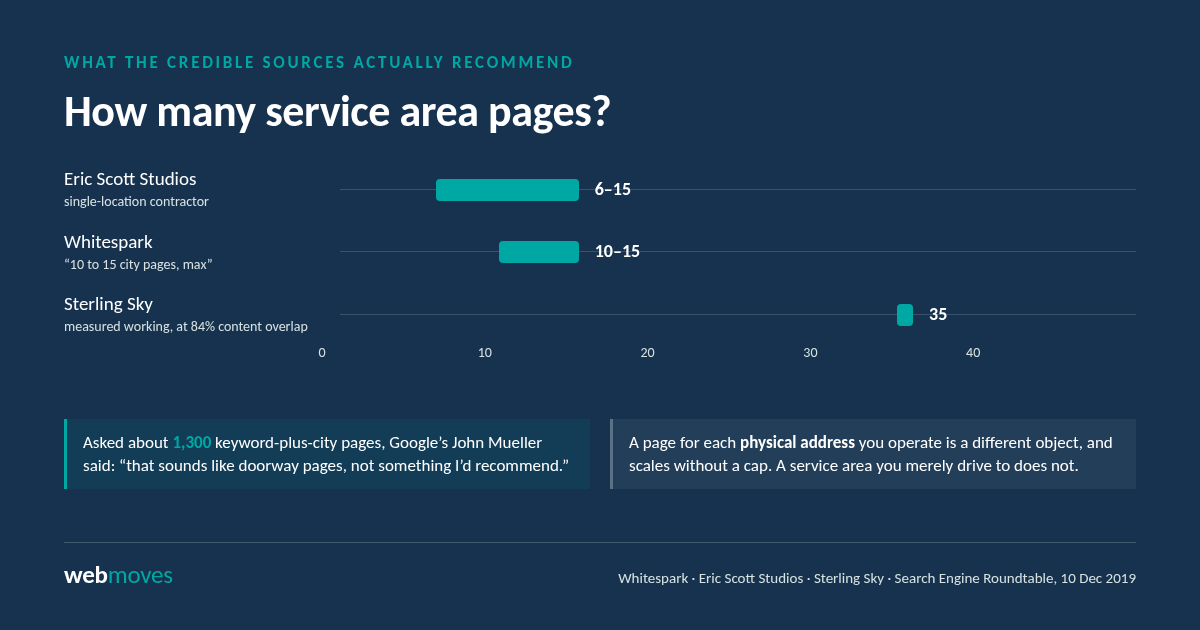
- Whitespark: “10 to 15 city pages, max.” Beyond that you start to look like doorway pages.
- Eric Scott Studios: six to fifteen for a single-location contractor. “Build for the 10 that matter.”
- Sterling Sky: 35, measured working — at 84% content overlap.
- Multi-location guidance: one page per physical location, no cap, each with its own Google Business Profile.
- John Mueller of Google: 1,300 is too many. Asked in December 2019 about building keyword-plus-city pages at that scale, he said: “That sounds like doorway pages, not something I’d recommend.”
Two things reconcile that list.
First, a page per physical address is a different object from a page per service area. If you have twelve branches, you should have twelve location pages, and nobody serious disagrees. A real address has a verifiable fact at its centre: it exists, you can drive to it, it has opening hours and a phone that rings there. A service area you merely drive to has no such fact unless you put one there.
Second, what matters is the share of your site, not the count. When Google’s Search API documentation leaked in 2024, one of the attributes it described was pandaDemotion, a site-level factor tied to the percentage of a domain that is thin or duplicate. Another, clutterScore, is a site-level signal that can be “smeared” across similar pages, which means a template problem is a site problem rather than a page problem.
Two hundred thin pages on a two-hundred-and-fifty-page site is most of your website. The same two hundred pages on a fifty-thousand-page site is a rounding error. The count on its own tells you nothing.
Our working answer, if you need a planning number before the analysis is done: ten to fifteen if the pages will be lightly differentiated, up to thirty-five or forty if every one will carry genuine local proof. Past that you need a reason for each page, not a policy that covers all of them.
What actually makes a page pass
If a page needs one fact that is true only for that town, here are the cheapest ways to put one there, ordered by effort. Most businesses never get past the first three, because they start by trying to write eight hundred words instead.
- Two or three reviews from customers in that town. You already have them, they are unique by definition, and they are the most persuasive thing on the page.
- Written-out driving directions for the area, rather than an embedded map. Genuinely unique text, genuinely useful, and almost nobody writes them.
- The named person who covers that patch — photo, a line about their territory, how long they have worked it.
- Real job photos from that town, captioned with the neighbourhood rather than the city.
- A permit, code, climate, water or housing-stock fact specific to that jurisdiction. This is where a tradesperson’s actual knowledge lives, and it is invisible to every competitor copying each other’s pages.
- A local FAQ built from what people in that market actually ask on the phone.
Eric Scott Studios puts the test more bluntly than we would: “If a page has no information that is true only for that town, it doesn’t ship.” Big Red SEO offers two more worth stealing. Put two city pages side by side, and if 90% of the content is identical, that is a red flag. And simply: would this page exist if search engines did not?
What is not on the list is word count. Sterling Sky’s study of 8,186 businesses across 200 cities found landing-page word count showed only a “slight correlation” with rankings. That study is worth reading for a separate reason, too: what did correlate strongly for “near me” searches was review velocity — reviews per month rather than total reviews — and review text rather than star ratings alone. If your map pack presence is the problem, no amount of page-building fixes it. Our analysis of what Local Services Ads cost per lead covers the other half of that equation.
The internal links
This is the half of the problem that gets ignored, and it is where the cheapest wins are.
Not all links are worth the same, and Google’s patent says how
The “reasonable surfer” patent (US8117209B1) replaced the idea that every link passes equal value with a model that weights each link by the probability somebody clicks it. The features it names are unusually specific:
the position of the link (measured, for example, in a HTML list, in running text, above or below the first screenful viewed on an 800×600 browser display, side (top, bottom, left, right) of document, in a footer, in a sidebar, etc.)
It also names font size, font colour, the number of words in the anchor, the actual words, how commercial the anchor is, whether it is a text or image link, and the few words either side of it. Google’s Gary Illyes has said the same thing in one sentence: footer links have much lower value than in-content links.
Which brings us back to that footer block. It is at the bottom of the page, it is boilerplate, it sits in a long list, and it divides the page’s outgoing value between every town you serve. It is the cheapest possible currency, and it is what most service-area sites are paying with.
What controlled tests show
Most SEO advice about internal links is somebody’s opinion. SearchPilot runs actual split tests, with pages randomised into control and variant groups and results measured with confidence intervals. Their published results are more useful than anything else in this area:
- Adding links to the six nearest regions across roughly 8,000 location pages, about twelve new links each: a 7% uplift in organic traffic to the pages receiving them.
- Expanding the homepage footer from about 30 internal links to more than 100: a 5% uplift to the destination pages.
- Rewriting existing anchor text, adding no new links at all: significantly positive for the destination pages.
- Reducing the number of links inside a single block: positive, because the remaining links improved.
- Adding more related-article links to blog posts: an uplift on the linking page, and nothing conclusive for the recipients.
- Repointing thousands of internal links away from 301 redirects: inconclusive, somewhere between −1% and +4%.
Four of those deserve to change how you work.
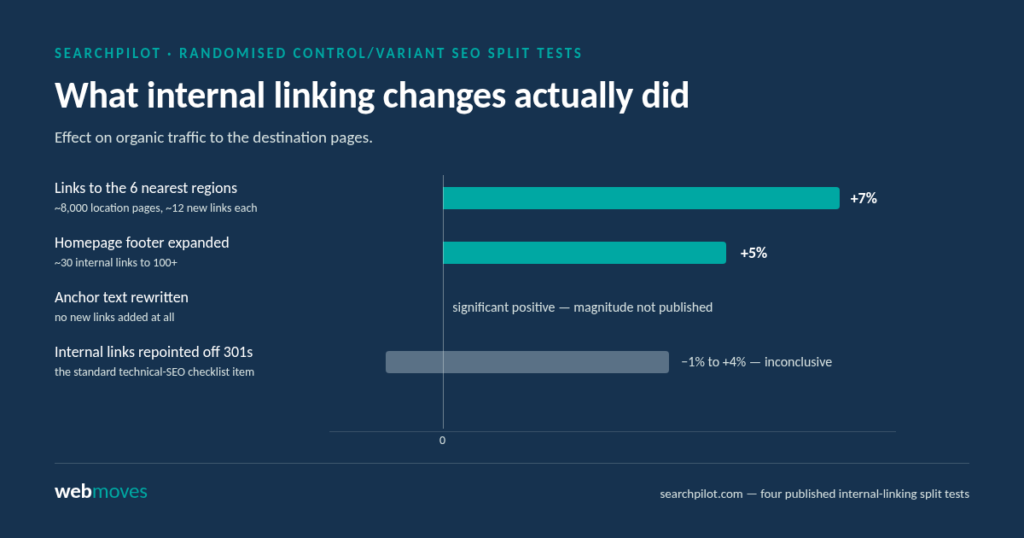
The location-page test is the closest thing to a direct answer anyone has published. Roughly twelve additional internal links per page, across eight thousand geographic pages, produced a 7% lift, and the authors’ explanation was that the pages had been starved of link equity. If your town pages are reachable only from the footer, that is your situation.
Rewriting anchor text, with no new links, moved rankings. No new pages, no new content, no crawl cost. We have not found anything else in this literature with that ratio of effort to evidence, and almost nobody does it.
Fewer links in a block beat more links, which is the dilution model showing up in a controlled test.
And fixing internal links that point at redirects did essentially nothing. That is a staple item on every technical SEO checklist. Do it for hygiene. Do not bill it as a ranking fix, and do not put it ahead of work that has evidence behind it.
What the big study says, and what it does not
Zyppy’s study of 23 million internal links across 1,800 sites is the largest dataset available. Pages with 0 to 4 internal links averaged two clicks from Google. Pages with 40 to 44 averaged four times that. Traffic peaked around 45 to 50 links and then declined. Pages with at least one exact-match internal anchor had five times more traffic than pages without one.
Those numbers get quoted everywhere as targets. The study’s author is more careful than his readers: “This is mostly a correlation study. Remember that correlation isn’t causation.”
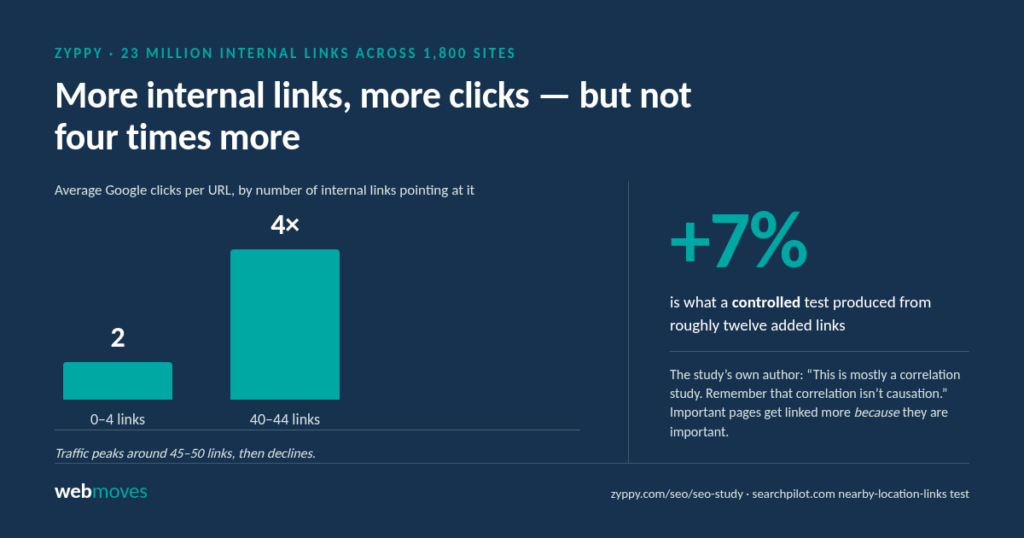
Important pages get more internal links because they are important. The controlled test above produced 7% from twelve links, not 400% from forty. Treat 40 to 44 as a description of what well-linked pages look like, not a quota to engineer toward.
One more mechanical detail, from Zyppy’s 2023 experiments: when several links on one page point to the same URL, Google counts at most about two anchors, typically the first text link and an image link, and ignores the rest. So linking to a town page from your navigation, your body copy and your footer passes far less anchor signal than three links suggests. And while we are here, “first link priority” is folklore. It comes from a single 2008 experiment, Google never confirmed it, and John Mueller said in 2018 that “this isn’t something we have defined”.
The structure that works
Hub and spoke, not sealed silos. An areas-served hub page links down to the town pages. Town pages link back up, sideways to genuine neighbours only, and across to the service pages they relate to. Anything you care about sits within three clicks of the homepage.
Anchors should be descriptive noun phrases of two to five words, written naturally in context. Never paste one anchor sitewide, and never spin variations mechanically — both patterns correlate with losses. And never use nofollow to sculpt where the value goes: it does not redirect the value, it destroys it, and that has been true since 2009.
If you already have too many, what now?
First, three free numbers
Before anybody argues about deleting anything, pull these from Search Console. They cost nothing and they usually settle it.
- What share of the fleet sits in “Crawled — currently not indexed”? Google’s Gary Illyes has confirmed that overall site quality affects this bucket, and that a very high count could hint at general quality issues.
- How many of the pages have ever received a single search impression?
- What fraction of your total indexed URLs is the fleet?
If most of the pages are indexed and picking up impressions, you have a deepening project. If a large share is unindexed or has never had an impression, you have a consolidation project. Those are different budgets, and the numbers choose for you.
Then find the cannibalisation
Four clicks in Search Console, no tools required. Performance report, three to six month range, Queries tab, click the query, switch to the Pages tab. If more than one URL appears for that query, those pages are competing with each other.
For a location fleet, run this on the query with no city in it. Sterling Sky’s warning is that city-service pages easily cannibalise each other for implicit keyword searches — the ones where the user names no town and Google infers it. Those are usually the highest-intent searches on the whole site.
Then pick the instrument, page by page
The instrument is decided by what the page has, not by how it performs.
- Nothing true only for it, but it has backlinks or traffic: 301 to the survivor.
- Nothing true only for it and nothing worth merging: 410. Prefer that to noindex for pages that are genuinely going, because a noindex tag can only be read by crawling the page, so the crawl cost stays.
- Near-duplicate but genuinely useful to a visitor: canonical to the primary.
- Needs to stay reachable for people, not for search: noindex, follow.
- Ranks between 3 and 20 on a keyword nothing else of yours targets: update it.
- Ranks between 3 and 20 on a keyword another page also targets: merge them.
- Passes the five questions and has real substance: keep it and deepen it.
When you merge, the surviving URL should be chosen on backlinks first, then ranking, then traffic — never on which page you like better. Log every removal: URL, reason, date, replacement. Work in batches of twenty or thirty with a fortnight between them. Mistakes are recoverable only if you wrote them down, and there is usually a dip before the recovery, which you cannot distinguish from a bad call if you changed four hundred URLs at once.
An honest word about the case studies
You will find impressive pruning numbers quoted everywhere. QuickBooks deleted 2,000 articles, more than 40% of their resource centre, and saw traffic up 20% within weeks and 44% by peak season. HubSpot removed 3,000 pages and saw the number of URLs crawled fall by 38%, with indexation times dropping from days to minutes. A vehicle valuation platform removed around five million pages and gained 160%.
Every one of those is a large site. The Animalz write-up says so directly: the sites that benefit most from pruning have “thousands, if not 100,000 or more pages”, while smaller sites — fewer than a thousand articles, less authority, fewer other acquisition channels — face materially higher risk and should try refreshes and internal linking first.
If you have two hundred location pages, you are not the site in those case studies. The reason to fix a weak fleet is that it is documented to drag on the rest of the domain, not that you should expect a 44% lift. Anyone promising you that number is selling.
And how long it takes
Longer than you want. Google evaluates quality partly at the site level. John Mueller: “if we see that there are significant parts that are lower quality then we might think overall this website is not so fantastic as we thought.” Glenn Gabe’s reading of Google’s guidance is six months minimum for a site-level reassessment, because Google has to recrawl and then accumulate fresh signals across the whole domain.
Measure on eight-week windows, and watch the “Crawled — currently not indexed” count as your leading indicator, because it moves before rankings do.
One last thing: check your sources
While researching this we kept running into statistics that sounded authoritative and turned out to be invented. “73% of programmatic SEO implementations fail within the first year.” “Pages with less than 300 words of unique content are four times more likely to be excluded from search results, per a Google study.” “Local landing pages with unique content rank three times higher than templated pages.”
None of those trace to anything. There is no such Google study. They circulate because they sound like the sort of thing that ought to be true.
Meanwhile Whitespark published a case study about service areas and later added a correction at the top of the post: “The conclusions I came to in this video & post are INCORRECT.” That is what a source worth trusting looks like.
Before you act on a percentage, find the study it came from. Most of the time there isn’t one. The same discipline applies to everything AI search is now repeating back to you, which is part of what makes a page legible to AI search in the first place.
Frequently asked questions
How many service area pages should I have?
There is no fixed number. Ten to fifteen if the pages will be lightly differentiated, up to thirty-five or forty if each one carries genuine local proof such as reviews from that town, real job photos and a named local person. Past that you need a specific reason for each page. A page for each physical address you operate is different and scales without a cap.
Will Google penalise me for duplicate content across location pages?
There is no duplicate content penalty. Google picks a canonical version. The risk is thin, purposeless pages rather than duplicated ones, and Sterling Sky has documented service area pages at 84% content overlap driving real traffic and conversions.
Are city pages doorway pages?
They can be. Google’s five doorway questions are the test, and the one most people miss asks whether the pages exist as an island, reachable only through links created just for search engines. A sitewide footer list of every town you serve is exactly that construction.
Should I delete my underperforming location pages?
Not on traffic alone. Around 96% of all pages get no traffic from Google, so “no traffic” describes the median page on the web. Use two conditions, such as traffic and conversions. Decide the instrument by what the page has: 301 if it holds backlinks, 410 if there is nothing worth merging, canonical if it is useful to a visitor.
What is the cheapest thing I can do to improve internal links?
Rewrite the anchor text on links you already have. A controlled split test changed existing internal anchor text without adding a single new link and saw a significant positive effect on the destination pages.
The summary
- The count is not the test. Google’s five doorway questions are, and they have been public since 2015.
- Question five ties the two halves together: links built only for search engines are themselves a doorway signal, so your footer block is not solving the island problem.
- A page per physical address scales. A page per service area does not, unless you put a real local fact on it.
- Duplicate content is not a penalty. Thin, purposeless pages are the problem.
- Reviews from that town, written directions, a named local person and real job photos will do more than another six hundred words.
- Rewriting the anchor text on links you already have is the best-evidenced cheap win available.
- Pull the three Search Console numbers before you argue about deleting anything.
- Nobody can tell you how much a weak fleet is costing you. The mechanism is documented; the magnitude is not.
If you would like a second opinion on a location-page set before you cut it, that is the kind of work our SEO and AI search team does every week.