

On 22 September 2026 we pulled six ordinary home services searches across five American cities and counted who Google put in front of the homeowner. A third of the top ten organic results were third-party aggregators — companies that don’t fix a pipe, replace a roof, or clean a house. Yelp appeared in the top ten of all six.
The first page, as it actually is
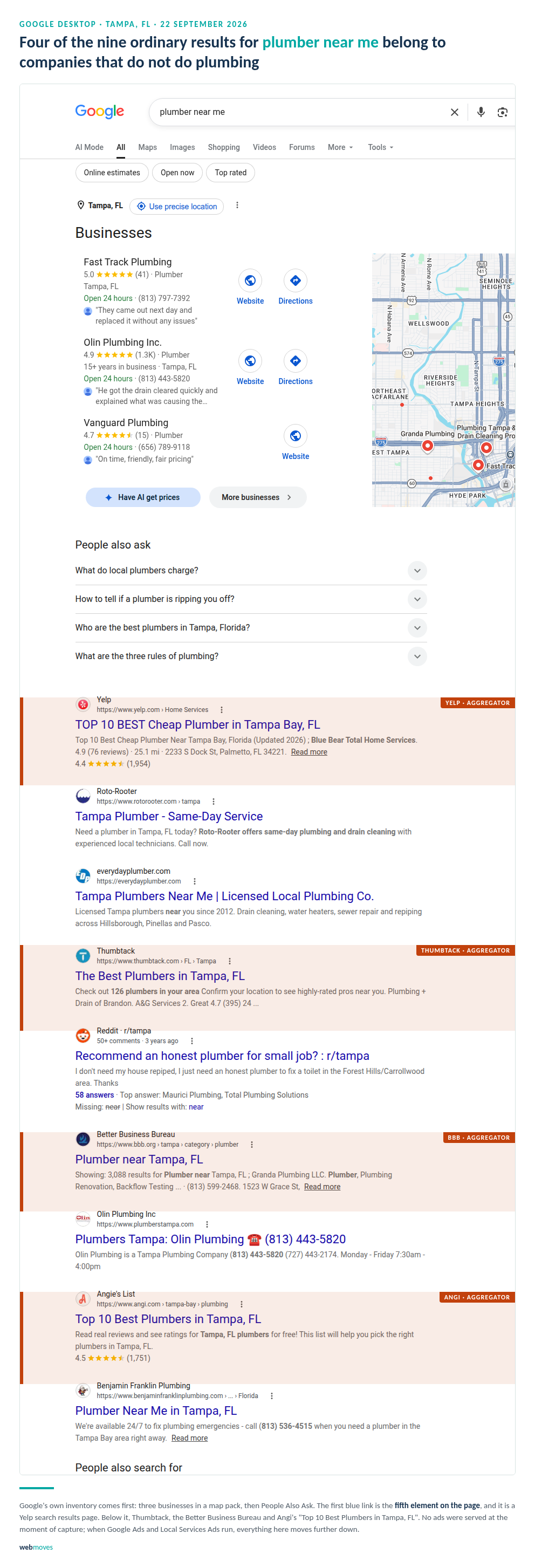
Search “plumber near me” in Tampa and here is what Google hands you, in order. First, three businesses in a map pack. Then a People Also Ask box. The first ordinary blue link is the fifth element on the page, and it’s Yelp — specifically, a Yelp search results page for “Cheap Plumber, Tampa Bay, FL”. You searched, and Google’s answer was somebody else’s search.
Below that: Roto-Rooter, a local plumber, then Thumbtack, then Reddit, then the Better Business Bureau, then another local plumber, then Angi’s “Top 10 Best Plumbers in Tampa, FL”. Then one more plumber. Then Angi’s “Top 10 Best Plumbers in Tampa, FL” again — the identical URL, served twice on the same page, at positions eight and ten.
Five of the ten organic results belonged to companies that will never come to your house.
That’s one search. We ran six.
| Search | City | Aggregators in top 10 organic | “Top 10” style titles |
|---|---|---|---|
| plumber near me | Tampa, FL | 5 | 4 |
| roof repair | Phoenix, AZ | 4 | 1 |
| electrician near me | Chicago, IL | 4 | 3 |
| house cleaning services | Austin, TX | 4 | 3 |
| hvac repair near me | Denver, CO | 3 | 3 |
| pest control near me | Tampa, FL | 1 | 1 |
| Total | 21 of 60 (35%) | 15 of 60 (25%) |
Yelp took eight of those twenty-one slots and appeared in every single search. Thumbtack made three of six. Angi made two of six, once with that duplicate. On the Phoenix roofing search, Google ran the same Yelp business page at positions seven and eight, directly beneath a Yelp search page at position two. Three of Phoenix’s top eight results were Yelp.
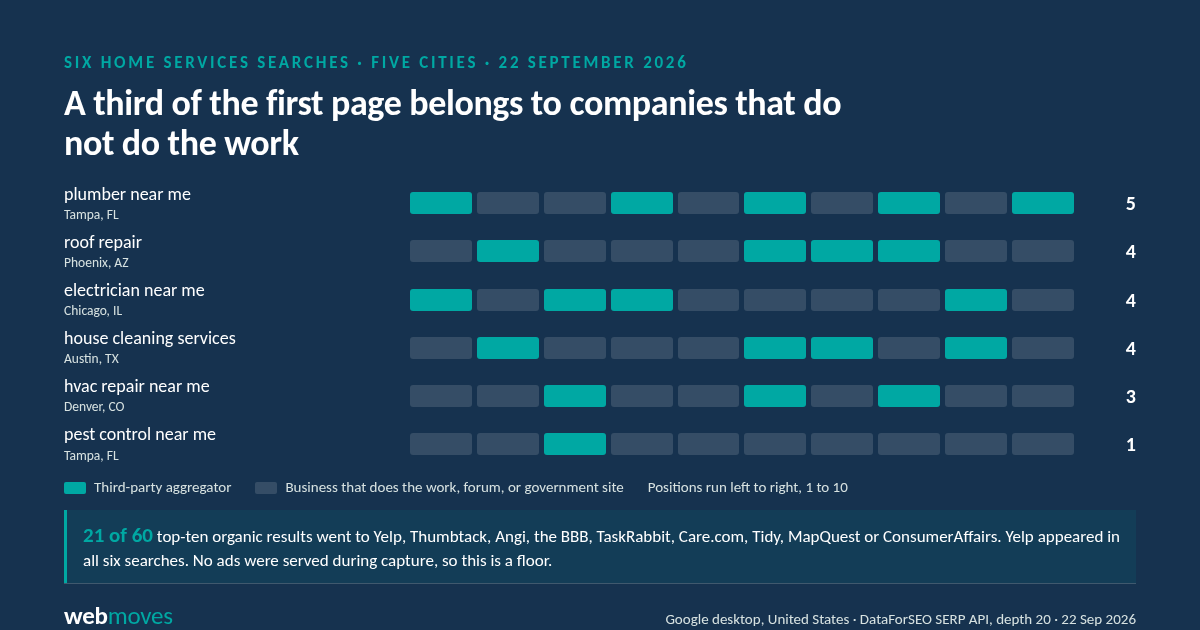
And none of these six searches served a single text ad at the moment we pulled them. When Google Ads and Local Services Ads are running — which for most of these categories is most of the time — everything above moves further down. Thirty-five percent is the conservative number.

What Google keeps, and what it rents out
Look at the order again, because the order is the whole argument.
The top of the page is Google’s own inventory: Local Services Ads, Google Ads, the map pack that runs on a Business Profile. That’s Google’s to sell, and fair enough — it’s their product and their page.
What’s striking is what happens to the space that’s left. Google doesn’t hand it back to the businesses. It hands it to a second tier of intermediaries who monetize the same click a second time. The homeowner clicks “Top 10 Best Plumbers in Tampa,” fills in a form, and that form becomes a lead that gets sold — sometimes to four plumbers at once, each of whom pays for it, only one of whom gets the job.
So a plumber in Tampa now competes for the same customer in three places, and pays in all three: Google Ads or LSA at the top, Google Business Profile optimization in the middle, and then Yelp, Thumbtack, Angi and HomeAdvisor for the right to be one of ten names on somebody else’s list.
Look at what’s actually on the page that outranks you
Here is a full screen of a Yelp search results page for “Bed Bug Exterminator” in Orlando.
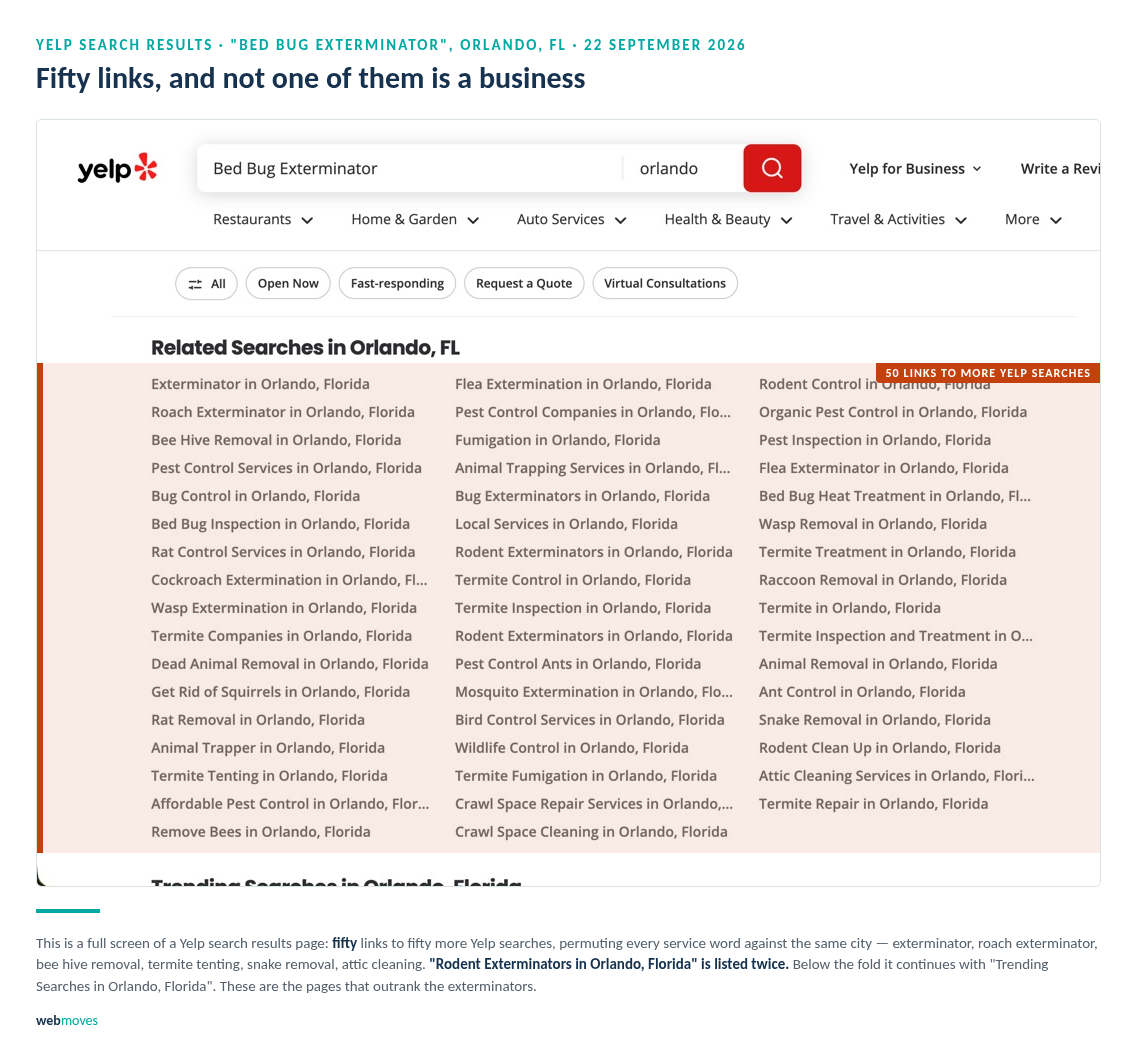
Fifty links, and every one of them goes to another Yelp search. Exterminator. Roach exterminator. Bee hive removal. Termite tenting. Snake removal. Attic cleaning services. Every service word Yelp can think of, multiplied by the city, each one its own URL. “Rodent Exterminators in Orlando, Florida” appears in the list twice, which tells you no human assembled it.
We published a piece a few days ago on how many service area pages a business should actually build, and the honest answer is a dozen or two. The reason is that when a contractor generates a page for every service crossed with every town he drives to, it stops being useful to anybody — Google’s own John Mueller, shown a site with 1,300 of them, said “that sounds like doorway pages, not something I’d recommend.” The full argument is in how many service area pages you should have.
Yelp does precisely that, in every category, in every city in the country, and ranks with it.
That’s the asymmetry in one screen. The small business gets told to consolidate. The aggregator doing the same thing a thousand times over gets the top of the page.
What “top ten list” really costs
Yelp is the clearest case because Yelp publishes its price list.
A Yelp business page is free. Everything that makes it work is not. As of September 2026, Yelp Ads start at $150 a month. The Upgrade Package — the one that gets you a call-to-action button, your logo, a photo slideshow, business highlights — is $180 a month, and one of its listed benefits is removal of competitor ads. Read that again: Yelp places your competitors’ advertising on your own business page, and then sells you the removal of it. The bundle of both runs from $270 a month, and only at that tier do you get the “ability to display a Verified License.”
That last one deserves a sentence of its own. Proof that you hold a valid license — a fact issued by a state, at your expense, that you already hold — is, in Yelp’s own words, “a paid feature available to businesses in certain categories and regions.”
None of that buys you a filtered lead. It buys you presentation on a page you don’t own, positioned against competitors you don’t choose, for a click Google already sent toward the category rather than toward you.
So what does a place on that list actually mean?
This is the part that should bother the searcher as much as the business owner.
“Top 10 Best Plumbers in Tampa, FL” is not a list. Nobody made it. Look at the URL Google ranked first for “plumber near me”:
yelp.com/search?find_desc=Cheap+Plumber&find_loc=Tampa+Bay,+FL
That’s a database query with a title tag on it. The word “Best” is template text, generated the same way for every service in every city. It reads like an editorial pick — ten plumbers, vetted, ranked — and it is a search box with a search term in it.
Now work through what a position on that page reflects.
The top of it is bought. In Yelp’s own description, Yelp Ads run in “Sponsored Results” sections above and below the organic results, and on competitor pages. So the first businesses a searcher meets on the page Google ranked number one are the ones who paid for the slot.
Your competitors are on your own page unless you pay. Yelp will tell you this itself, in the guide it writes for business owners: “The majority of free Yelp Pages have competitor ads in the center of the page.” That is the default state. The $180 a month buys it back.
Presentation is priced line by line. Your logo. A contact button. Proof of the licence your state already issued you.
And the reviews — the one element that’s supposed to carry a quality signal — are the least reliable part of the whole thing. Reviews Yelp’s software doesn’t recommend count toward neither the star rating nor the review count. A customer who went out of their way to say something good can simply not exist as far as that page is concerned.
So: placement at the top, purchasable. Presentation, purchasable. Keeping rivals off your own page, purchasable. Reviews, filtered by a system you cannot see or appeal. The ordering of everything below the paid slots is Yelp’s own algorithm, which Yelp says advertising does not influence — and which nobody outside Yelp can check, because the page refuses automated inspection. We tried twice, from two directions, and got a 403 both times.
Then set that against the 10-K. Ninety-five cents of every dollar Yelp earns comes from the businesses on the list. Nothing comes from the person reading it. When the people on the page are the customers and the person reading the page is the inventory, you don’t have to speculate about whose experience gets optimised.
That’s the answer to “what does Yelp add.” For the homeowner, a ranked list whose ranking they can’t interpret. For the plumber, an invoice.
The reviews problem
Yelp’s recommendation software is automated, and it decides which reviews count. Reviews it doesn’t recommend do not factor into the business’s star rating or its review count. They’re not deleted — they sit behind a “reviews that are not currently recommended” link at the bottom of the page that almost nobody clicks.
In practice, across multi-location service clients, what we see is locations showing a zero review count on a page that has a stack of reviews sitting behind that link, and the handful that do get through skewing to the unhappy ones. A customer who went out of their way to say something good disappears; the one bad night stays.
You cannot appeal it, you cannot see the rules, and paying Yelp does not change it — Yelp is explicit that the software treats advertisers and non-advertisers identically. Which is either reassuring or the point, depending on how you look at it: you’re paying a company for visibility on a profile whose most important content it will not let you influence.
Google reviews, by contrast, sit on an asset you control, feed the map pack, and increasingly feed what AI assistants say about you. That asymmetry is most of the reason we tell service businesses where to put their review effort, and we went through the evidence for it in AI now finds local businesses, but reviews still decide them.
Follow the revenue
Yelp’s 2025 annual results, filed with the SEC in February 2026, tell you exactly what the business is.
Net revenue: a record $1.46 billion. Advertising: 95% of it. The growth engine is services — home services, contractors, the trades — where advertising revenue rose 8% to a record $948 million.
Now the number that matters. Total paying advertising locations fell 3% over the year, while average revenue per location hit an annual record.
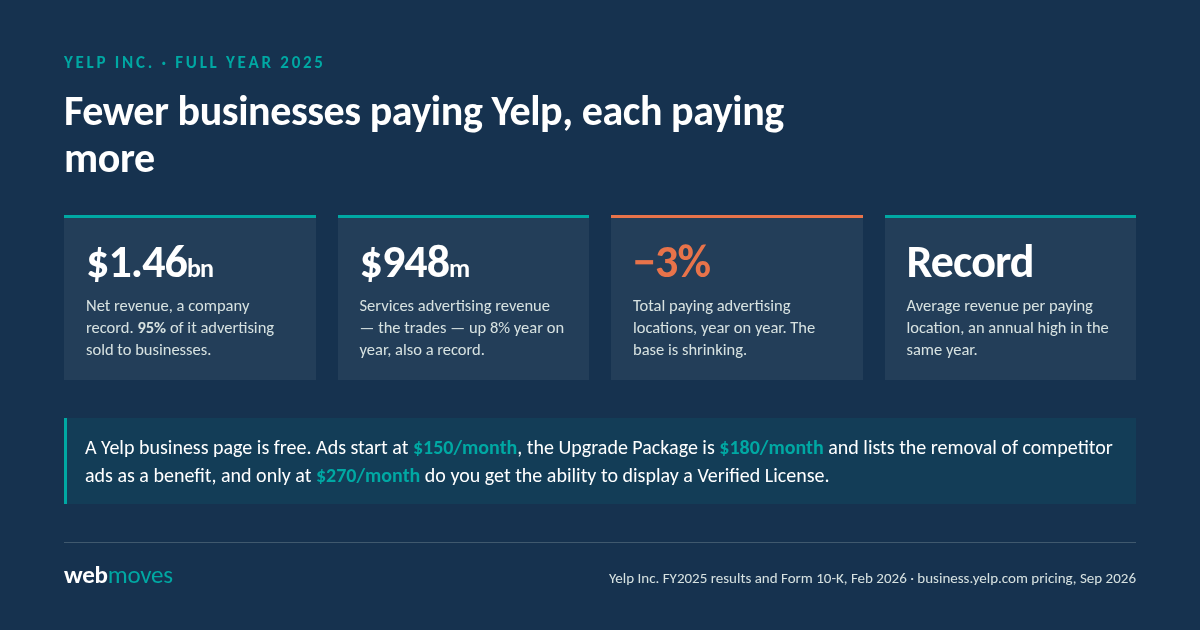
Fewer businesses, paying more each. That is not a company whose value to small business is increasing. It’s a company extracting more from a shrinking base — which is what happens when the product’s real moat isn’t usefulness, it’s a search ranking.
And the leads themselves
In January 2023 the Federal Trade Commission ordered HomeAdvisor — an Angi company — to pay up to $7.2 million and to stop deceptively marketing its leads. The FTC’s complaint alleged that since at least mid-2014 the company had made false, misleading or unsubstantiated claims about the quality and the source of the leads it sold to service providers, and that it told providers its leads converted into jobs at rates it could not substantiate. The order was finalized in April 2023. That November the FTC mailed 110,372 checks to home service providers.
A hundred and ten thousand small businesses, identified by a federal regulator as having been sold something other than what they were promised. That is not an edge case or a bad sales rep. That’s the model.
What does the searcher get?
Here’s the question nobody at Google seems to be asking: why is any of this a good search result?
Someone types “plumber near me” at 9pm with water on the floor. The best possible answer is a plumber. What they get, roughly half the time, is a list of ten plumbers assembled by a company with no opinion about plumbing, whose top slots are sold, and which will hand their phone number to four of them.
A directory that sends you to a directory is not an answer. It’s a toll booth with good SEO.
And people have worked this out for themselves. Here’s “hvac repair miami” on the same day: one real air conditioning company at the top, Yelp’s “TOP 10 BEST” list directly underneath it, and then, further down, a Discussions and forums panel that Google built and Google chose to show.
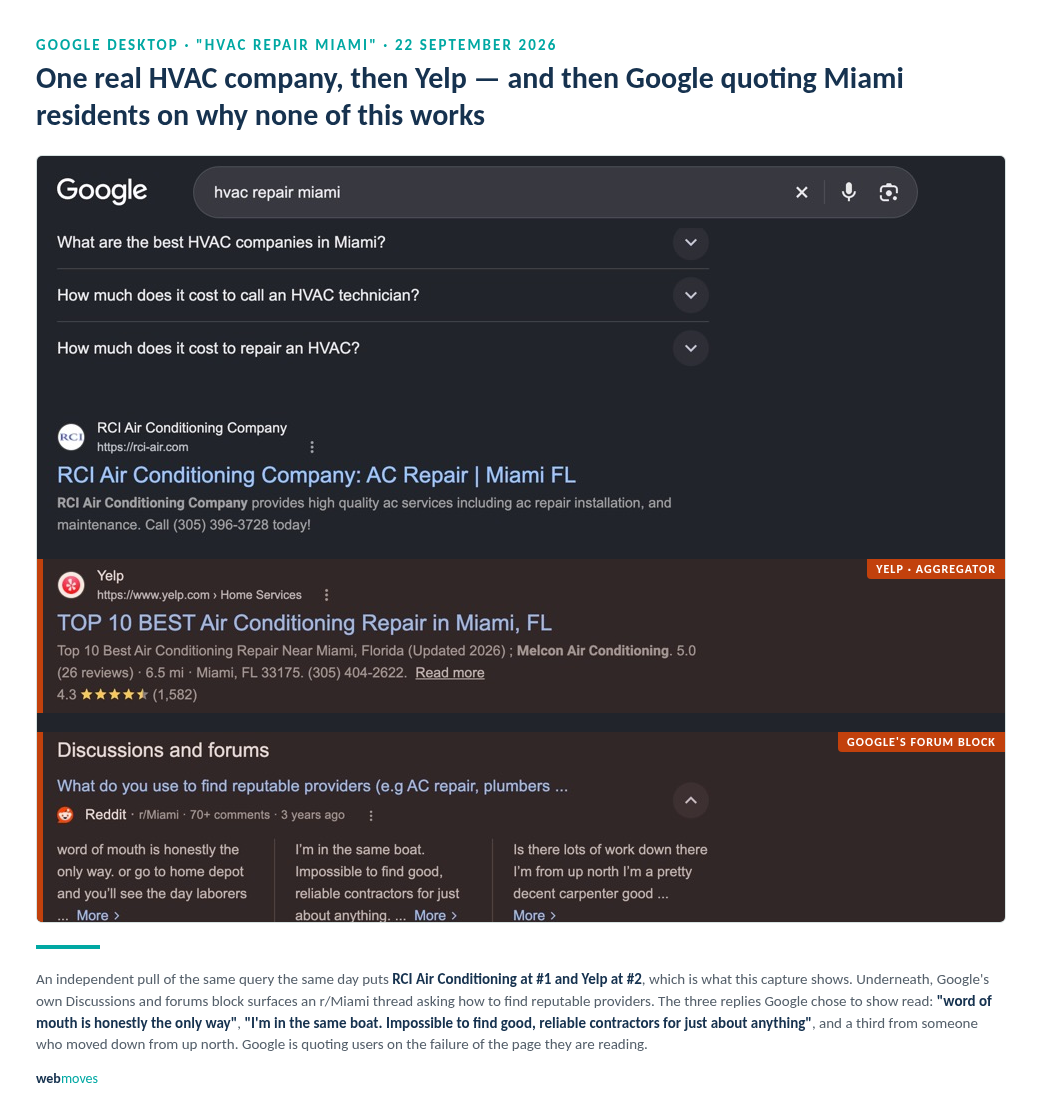
The thread is r/Miami asking how you find a contractor you can trust. The three replies Google picked out to display: “word of mouth is honestly the only way,” “I’m in the same boat. Impossible to find good, reliable contractors for just about anything,” and a third from somebody who’d moved down from up north and given up the same way.
Read that again with the ranking in mind. On one screen, Google ranks the directories and then quotes local people explaining that the directories don’t work and they ask a neighbour instead. Google is publishing the review of its own results page, directly underneath its own results.
We used to recommend these sites. That’s the part that stings.
Here’s Web Moves in April 2010, in a post that is still live on this blog:
“Local internet business directories can help your business out locally… It doesn’t take long to sign on to local business directories, and in most cases it’s free. Three local directories you should check out are Yelp, Yahoo! Local, and Bing Local.”
— Local Business Directories Yelp, Yahoo! Local, and Bing Local, Web Moves, 2 April 2010
That advice was correct in 2010. A free listing, a few genuine reviews, another way for a local customer to find you. The directory sat beside your website and pointed at it.
Sixteen years later the same directory outranks your website for your own service in your own city, charges you $270 a month to look presentable on it, hides the reviews your customers wrote, and sells your prospect’s phone number to your three closest competitors. The listing didn’t get better. It got leverage.
I don’t think this is a conspiracy. I think it’s an incentive.
I can’t tell you what’s in the heads of the people who tune Google’s ranking systems, and I’m not going to pretend I can. What I can tell you is what the incentives point at, and where the money ends up.
Aggregators are, by every signal Google’s systems are built to reward, excellent websites. Enormous domain authority. Thousands of pages per city. Fast, structured, templated, constantly refreshed, stuffed with entities and reviews and schema. A one-truck HVAC company in Denver is never going to win that comparison on the metrics as they’re currently weighted. So the algorithm does what the algorithm was told to do, and a category of business that produces no service whatsoever occupies a third of the commercial real estate on the first page.
And the money that leaks out doesn’t come from nowhere. Every dollar a contractor sends to Thumbtack, Yelp, Angi and HomeAdvisor is a dollar not spent on Google Ads, not spent on Local Services Ads, not spent on their Business Profile, and not spent on the content and the site that would let them earn that ranking directly. Google is routing its own advertisers’ budgets to intermediaries who then buy Google traffic with it — wholesale, at scale, more efficiently than any single contractor ever could.
That’s not a stable arrangement for anyone. Small service businesses run on margins that don’t survive four subscription fees. When they fail, or when they finally cancel everything, the budget doesn’t move to Google. It stops.
What to actually do about it
Complaining about the SERP is not a strategy. Here’s what we tell clients, and most of it is simply the discipline of not paying for what you can’t measure.
- Audit every aggregator invoice against booked revenue, not leads. Not calls, not form fills, not the dashboard’s own number — booked jobs with a dollar value attached, traced back to source. Most service businesses have never done this honestly, and the ones who do usually cancel at least one subscription the same week.
- Take the space Google still gives you directly. Local Services Ads and the map pack sit above every aggregator on the page, and they’re won with reviews, response time, service area accuracy and a properly managed profile rather than with a monthly listing fee. If you’re going to pay for placement, pay for the placement that’s above the toll booth — our breakdown of what Local Services Ads cost per lead has the numbers, and we manage those campaigns as well.
- Put your review effort where reviews compound. Google first. Reviews there feed your ranking, your map pack, your ads and what AI assistants repeat about you — and nobody filters them into a drawer.
- Remember that half the page is still yours. In every search we ran, real providers held the majority of the top ten. Those rankings went to businesses with a real site, real service pages, and real local depth. That’s a winnable fight, and it’s the only slot on the page nobody can raise the rent on.
- Be honest about the exceptions. Some businesses genuinely do get work from Thumbtack, and a new company with no site and no reviews may rationally buy leads for a year. Aggregators aren’t useless to everyone. The argument here is about proportion and direction: about a third of the commercial first page going to intermediaries, and the fee load on the people doing the work rising every year while the value they get for it doesn’t.
How we measured this
Six queries, five cities, pulled live from Google desktop US on 22 September 2026 via the DataForSEO SERP API at depth 20: plumber near me (Tampa), roof repair (Phoenix), hvac repair near me (Denver), electrician near me (Chicago), house cleaning services (Austin), pest control near me (Tampa). We counted the first ten organic results per query and classified a domain as an aggregator where the site sells leads, advertising or directory placement to the providers it lists — Yelp, Thumbtack, Angi, HomeAdvisor, HomeGuide, BBB, TaskRabbit, Care.com, Tidy, MapQuest, ConsumerAffairs. Forums, classifieds, manufacturers, franchises and national service brands were counted as providers, not aggregators, which makes 35% a floor rather than a ceiling. No paid ads were served in any of the six scrapes. Anyone can re-run it.
Two captures in this piece sit outside that sample and are not counted in the 35%: the Yelp page for “Bed Bug Exterminator” in Orlando, and “hvac repair miami”, which we pulled separately to check it matched.
One footnote from the raw data, because it says something on its own. Two of the six “near me” searches ran out of relevant results before the bottom of the first page. In Denver, the tenth organic result for “hvac repair near me” was an MIT Sloan article titled Me, Myself, and AI. In Chicago, the tenth result for “electrician near me” was Lime’s e-scooter homepage, at li.me. Keep scrolling to page two and you get Merriam-Webster’s definition of the pronoun “me”, a Taylor Swift single, and two recipes for Marry Me Chicken.
Google could not find twenty relevant results for “electrician near me” in Chicago, a city of 2.7 million people. It found nine, gave three of those nine to companies that don’t do electrical work, and filled the rest with song lyrics.
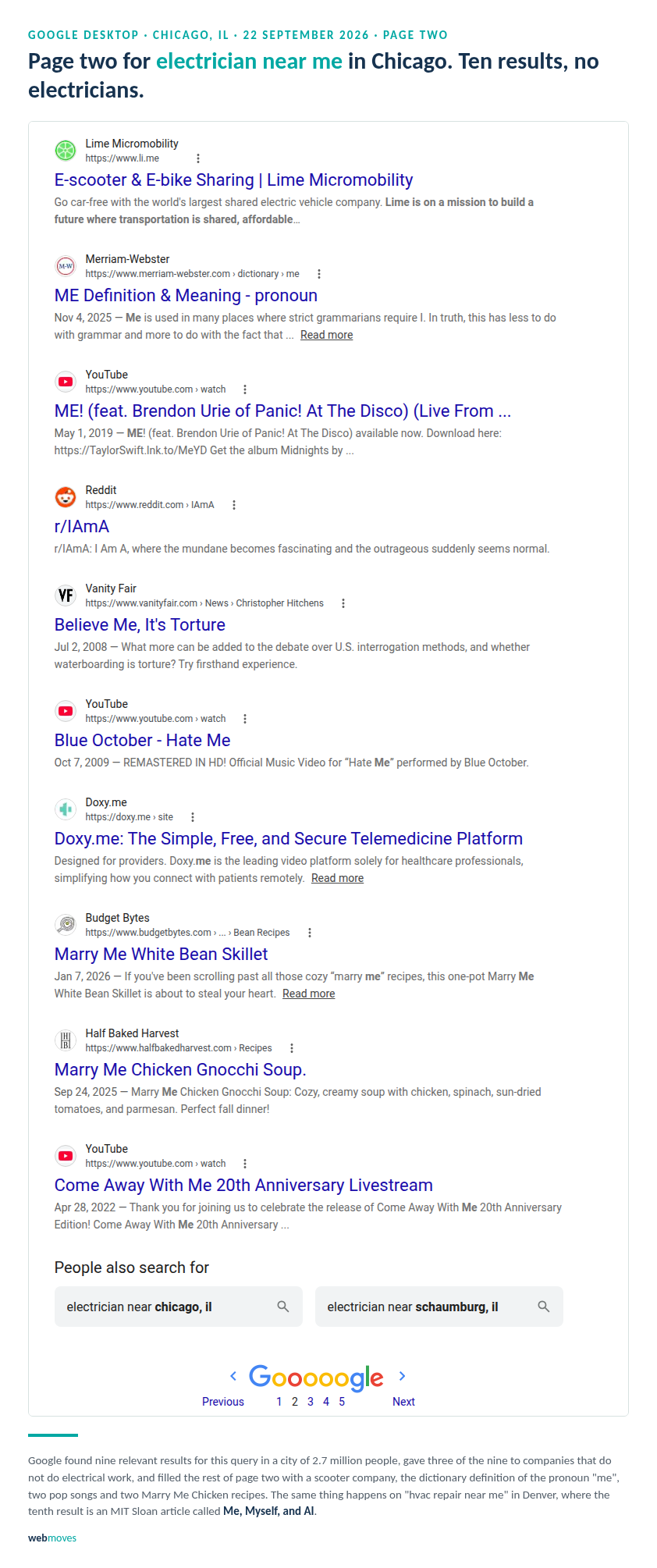
It isn’t only Chicago. On the corroborating pull we ran for “hvac repair miami”, the tenth organic result was a YouTube video titled “The Most Insane Headstock Repair We’ve Ever FINISHED!” — a guitar repair.
If the first page of your own category looks like the ones above, that is the problem worth solving, and it is the kind of work our SEO and AI search team does every week.